November 14, 1969: Lightning Strikes Apollo 12 Twice on Liftoff and One Quick Switch Saves the Second Moon Landing
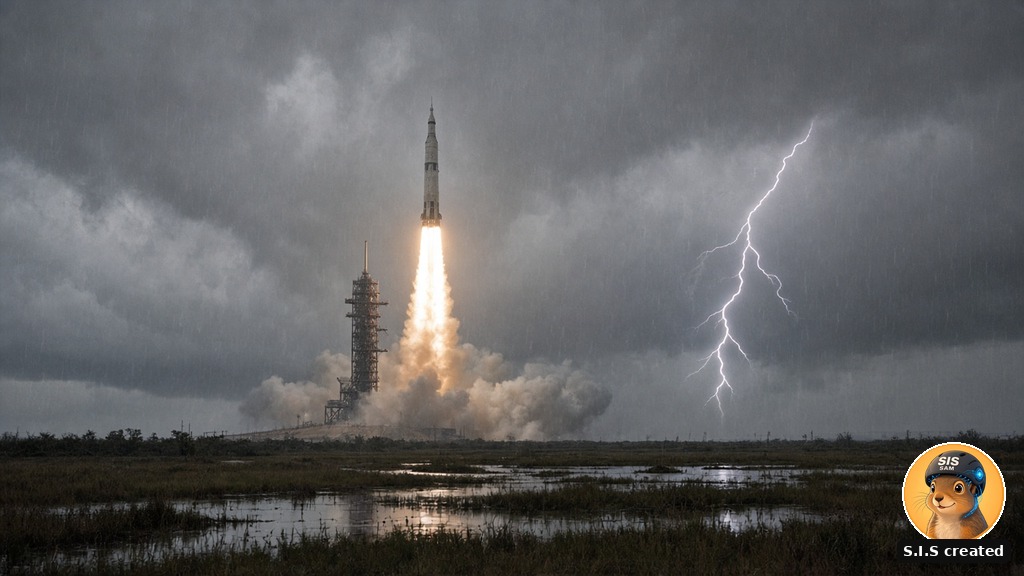
On a gray, rainy morning at Kennedy Space Center, Apollo 12 lifted off at 11:22 a.m. Eastern time on November 14, 1969, carrying astronauts Pete Conrad, Richard Gordon and Alan Bean toward the second Moon landing. The giant Saturn V climbed straight into the clouds of a passing cold front, and the weather had a surprise waiting.
At 36.5 seconds after liftoff, about 6,000 feet up, lightning flashed down through the rocket and its long exhaust plume. At 52 seconds it happened again. Warning lights lit up the spacecraft, and readings on the ground turned to gibberish.
In Mission Control, flight controller John Aaron recognized the strange pattern from an earlier test. His suggestion, "SCE to AUX," switched the Signal Conditioning Electronics to their auxiliary setting. Alan Bean found the switch, flipped it, and the data came back. The rocket's guidance had kept flying true the whole time, and the crew went on to orbit and then to the Moon.
NASA's later analysis found something new: the rocket itself had likely triggered the lightning. A tall vehicle trailing a long, electrically conductive plume through charged clouds could set off a strike that the sky would not have produced on its own. That lesson changed launch weather rules, and today launch teams watch cloud types and electric fields closely before any countdown reaches zero.
Five days later, Conrad and Bean landed on the Ocean of Storms, a fitting name after that stormy start.
Sam's Take: Lightning twice in one minute? I once got bonked by two acorns in one minute and had to lie down. Those astronauts just flipped a switch and kept going to the Moon! My SIS-SAM helmet is rated for acorns, not thunderbolts, so I'll stay grounded with a bowl of beer nuts and a weather radio. SCE to AUX, friends!
On This Day in History
Join The Daily Reflector
Become a subscriber and get full access to discussions, member stories, and exclusive content from our editors.
Subscribe Now →